
 SyahrWorks
Research & Development
Developing an Efficient PPDB System Integrating Payment Gateway and Secure Exams
Publication
The research behind this article was published in a peer-reviewed journal:
| Item | Detail |
|---|---|
| Journal | Computer Science (CO-SCIENCE) |
| Issue | Vol. 6 No. 1 (2026): January 2026, pp. 48–56 |
| Published | January 1, 2026 |
| Authors | Muhammad Rohman Syah, Deny Novianti M.Kom, Roynaldy Rosdiyanto |
| DOI | 10.31294/co-science.v6i1.10103 |
Read the full paper: jurnal.bsi.ac.id — article 10103
Introduction
The new student admission process (PPDB) is a critical gateway for any educational institution. However, SMKS Jakarta 1 Pondok Kopi faced a significant 35.4% decline in applicants between 2021 and 2024, caused by an inefficient and fragmented admission system.
The core problems include:
- Outdated information platforms — prospective students struggled to access accurate enrollment information.
- Complex multi-platform registration flow — applicants had to move between platforms, increasing the risk of input errors.
- Error-prone manual payment verification — payment records were matched one by one by hand.
- Insecure online exam system — vulnerable to cheating and unreliable.
Research Objectives
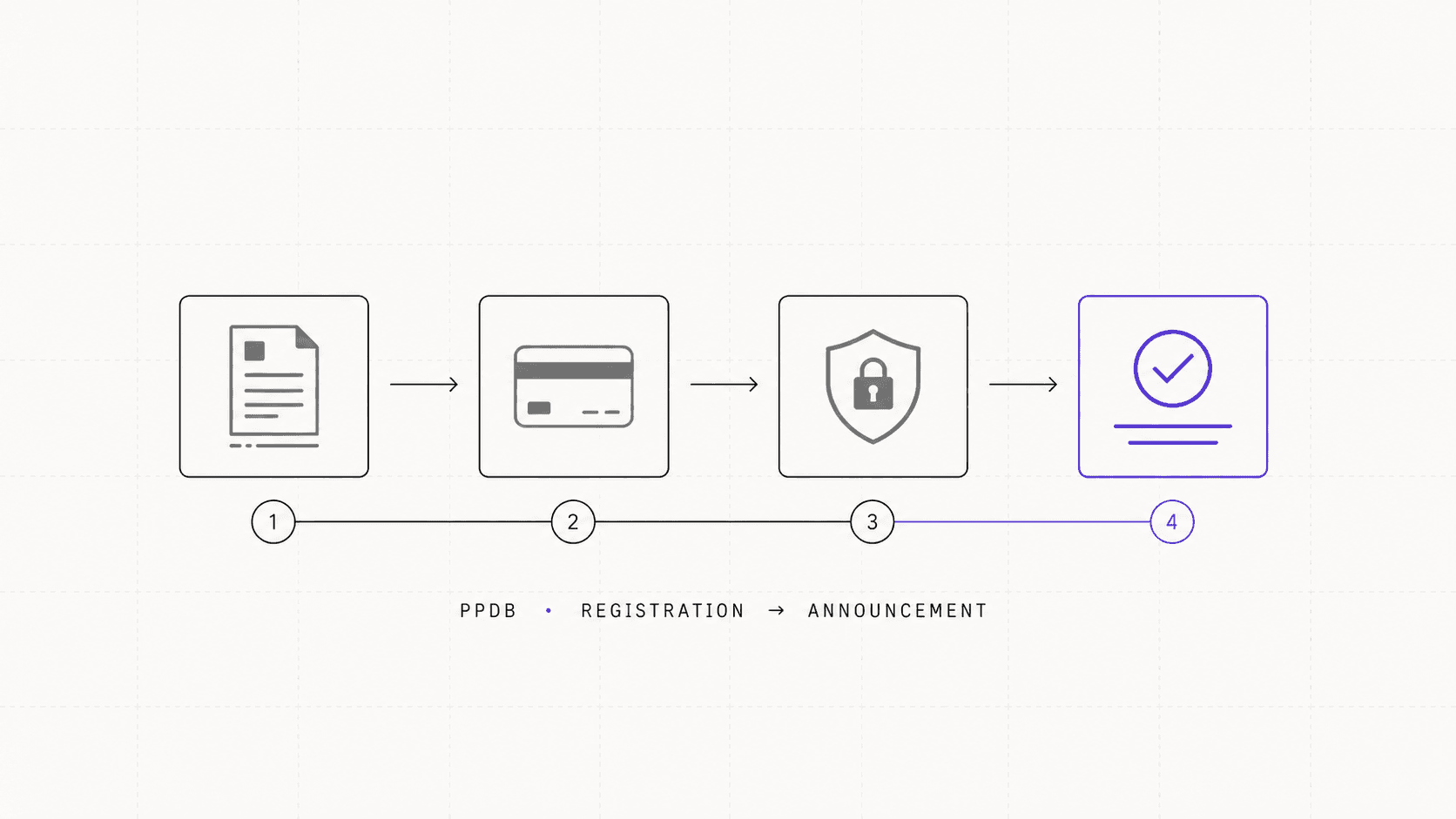
This research aims to develop an integrated web-based student admission (PPDB) information system that combines every stage into one complete flow:
- Registration — enrollment of prospective students in a single unified platform.
- Digital payments — payment gateway integration so payment verification is automatic and accurate.
- Online exam with anti-cheating features — a secure and supervised selection process.
- Centralized announcements — results are published through one official channel.
Methodology
The system was developed using the Waterfall model, applied in five stages:
- Requirements analysis — collecting the school's admission workflow and pain points.
- Design — modeling the integrated system and its database.
- Implementation — building the web-based system, including the payment gateway and online exam modules.
- Testing — verifying each feature against expected behavior.
- Maintenance — supporting deployment and future refinements.
Evaluation was carried out in two stages:
| Stage | Method | Result |
|---|---|---|
| Functional Testing | Black Box Testing | All functionality worked as expected |
| User Acceptance | User Acceptance Testing (UAT) | Average score of 4.48/5.00 from prospective students and 4.50 from the committee |
The UAT results produced a final interpretation of "Very Good", showing that the system was very well received by both user groups.
Practical Implications
Implementing this system delivered significant improvements in:
- Administrative efficiency — registration, payment, and announcement processes no longer take a long time.
- Data accuracy — automated payment verification reduces human error.
- Modernized school services — an image of the school as a technology-adaptive institution.
Research Contribution
This research contributes by providing and validating an effective integrated PPDB system model, proving it as a comprehensive solution for vocational education institutions — not only for SMKs, but adaptable by other educational levels.
Conclusion
The integrated PPDB system with payment gateway and anti-cheating online exam proved effective in solving the previously fragmented enrollment problem. With a "Very Good" acceptance level, this model becomes a reference implementation for educational institutions that want to modernize their academic administrative services.
Written by Muhammad Rohman Syah